
Workplace EV charging: what businesses need to know before fitting chargers
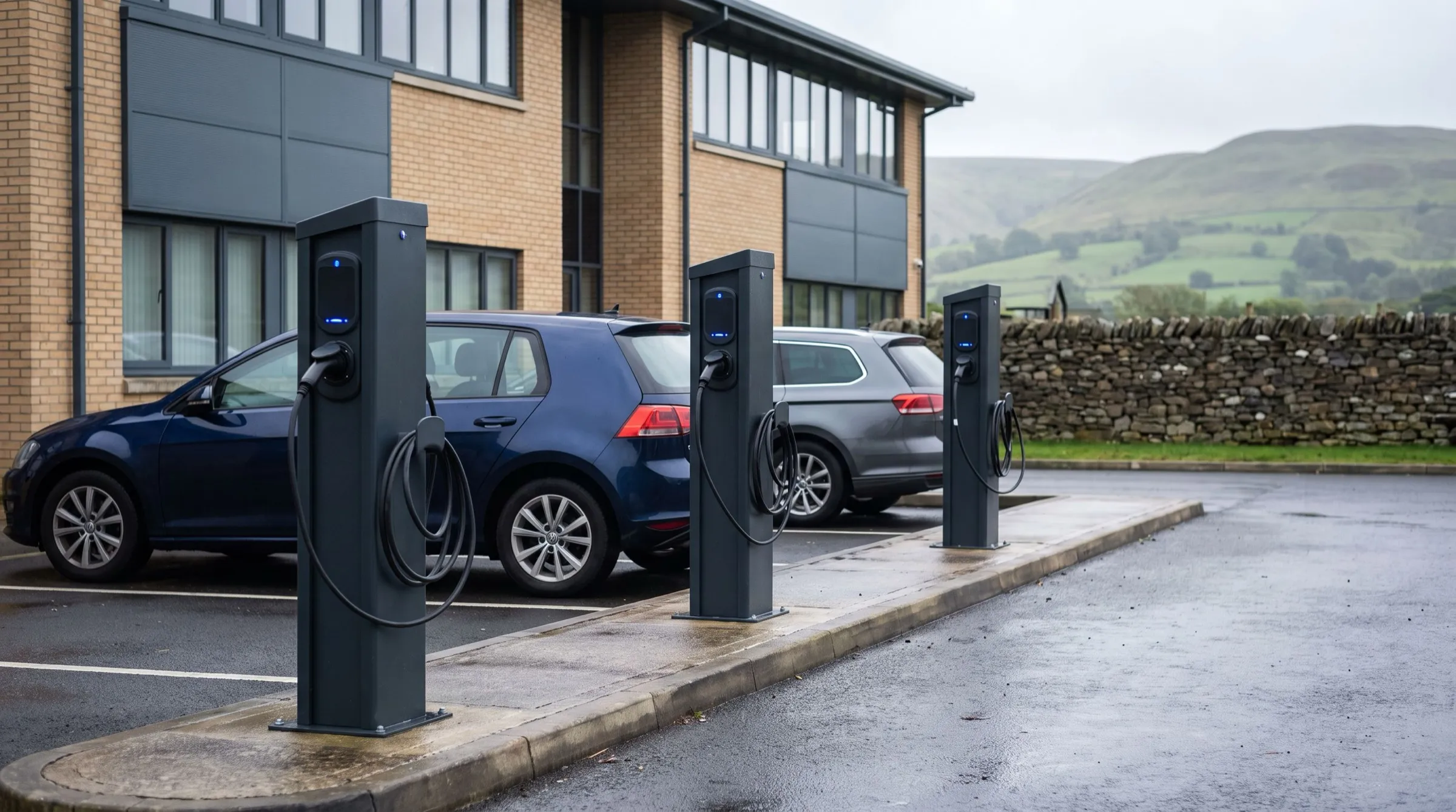
Workplace EV charging means chargers in your staff or fleet parking, used while vehicles sit there during the working day. Most sites only need 7kW or 22kW units, not rapid chargers.
What it costs comes down to three things: how many sockets you need, whether your supply can take them, and whether the Workplace Charging Scheme applies. That grant is worth up to £500 per socket and is funded until 31 March 2027.
We fit EV chargers for business across North Yorkshire and the North East, and every site we survey is on Northern Powergrid’s network. The grant, tax and network rules below were checked against gov.uk and Northern Powergrid on 31 October 2026.
What is workplace EV charging?
Workplace EV charging is a set of chargers at a place of work that staff and company vehicles use while they’re parked for the day. Because cars stay put for hours, AC chargers rated at 7kW or 22kW do the job, and rapid DC chargers built for short stops rarely make sense.
Northern Powergrid’s EV charging guide makes the same point: slow chargers ‘could be suitable for business where employees are working for eight hours’.
22kW needs a three-phase supply, and many cars can’t take more than 11kW on AC anyway. For most staff car parks, 7kW is the sensible default.
What counts as a socket
A socket is one charging connection, so one car charging at a time. A twin-socket charger charges two cars at once and counts as two sockets.
That matters because the grant is paid per socket, not per charger. Two twin-socket pedestals are four sockets.
Who can use your chargers, and who pays?
If a business claims the Workplace Charging Scheme, its chargers have to serve staff or fleet parking. You can let local residents use them outside working hours, but parking used only by customers doesn’t qualify.
Decide who the chargers are for before you apply, because it shapes the grant, the charger and the software.
Staff and fleet
This is what the scheme is built for. Pool cars, company vans and staff’s own cars can all use grant-funded chargers in your car park.
The scheme guidance also lets businesses open the chargers to local residents outside office hours, which some sites use to recover running costs.
Visitors, customers and the public
Parking that’s solely for customers isn’t eligible for the grant if you’re a business. Public authorities, charities and small accommodation businesses are treated differently: they have no restriction on who uses the chargers.
If you open chargers to the public, they have to meet the Public Charge Point Regulations 2023. That brings its own rules, including on payment and price information, so it’s a different project from staff charging.
Free, subsidised or paid
The chargers we fit support free access, staff-only access by app or fob, and paid charging. Many employers start free for staff and add a tariff later once they know how much the chargers are used.
Whatever you pick, write a short charging policy and share it before switch-on:
- who can use the chargers, and when
- whether staff pay, and how
- move your car once it’s charged, so the next driver can plug in
- fleet vehicles first, if you run them
How many chargers does your workplace need?
Start with one socket for every one or two EV drivers who park all day. At 7kW, eight hours adds up to 56kWh, which is more than most drivers use in a day.
Two drivers can share a socket if one plugs in for the morning and the other after lunch.
Most guides skip this question, so here’s how we work it out on a survey.
Offices and business parks
Count the EV and plug-in hybrid drivers who park on site now. Then ask who’s due a new company car, because that’s when most staff switch.
Fit enough sockets for today’s drivers, with the cabling for the next round already in place. Over-fitting on day one ties up money in chargers that sit idle.
Depots and vans
Vans that come back to base every night have 12 hours or more on charge. That means each van needs far less power than a staff car topping up during the day.
Load management shares the supply across the chargers overnight, so a row of vans can be ready for the morning without a bigger connection. We plan it around when vehicles come in and leave, not around the number of bays.

Plan for the next chargers now
The expensive part of a workplace job is often the ground, not the chargers. Digging up tarmac twice costs more than laying spare ducting once.
We size cabling and ducts for the chargers you’ll want in a few years, so adding them later is a smaller job. Keep the grant’s limit in mind too: 40 sockets across all your sites, including anything you’ve claimed before.
Does your site have enough power?
Often, yes. A pair of 7kW chargers will run on many single-phase supplies with load management, and larger banks usually need three-phase.
Some sites need a supply upgrade from the DNO, which adds a stage before we can switch on.
The DNO is the distribution network operator, the company that owns the cables and substations bringing power to your building. Across North Yorkshire and the North East that’s Northern Powergrid, which serves ‘the North East, Yorkshire and northern Lincolnshire’.
Load management before upgrades
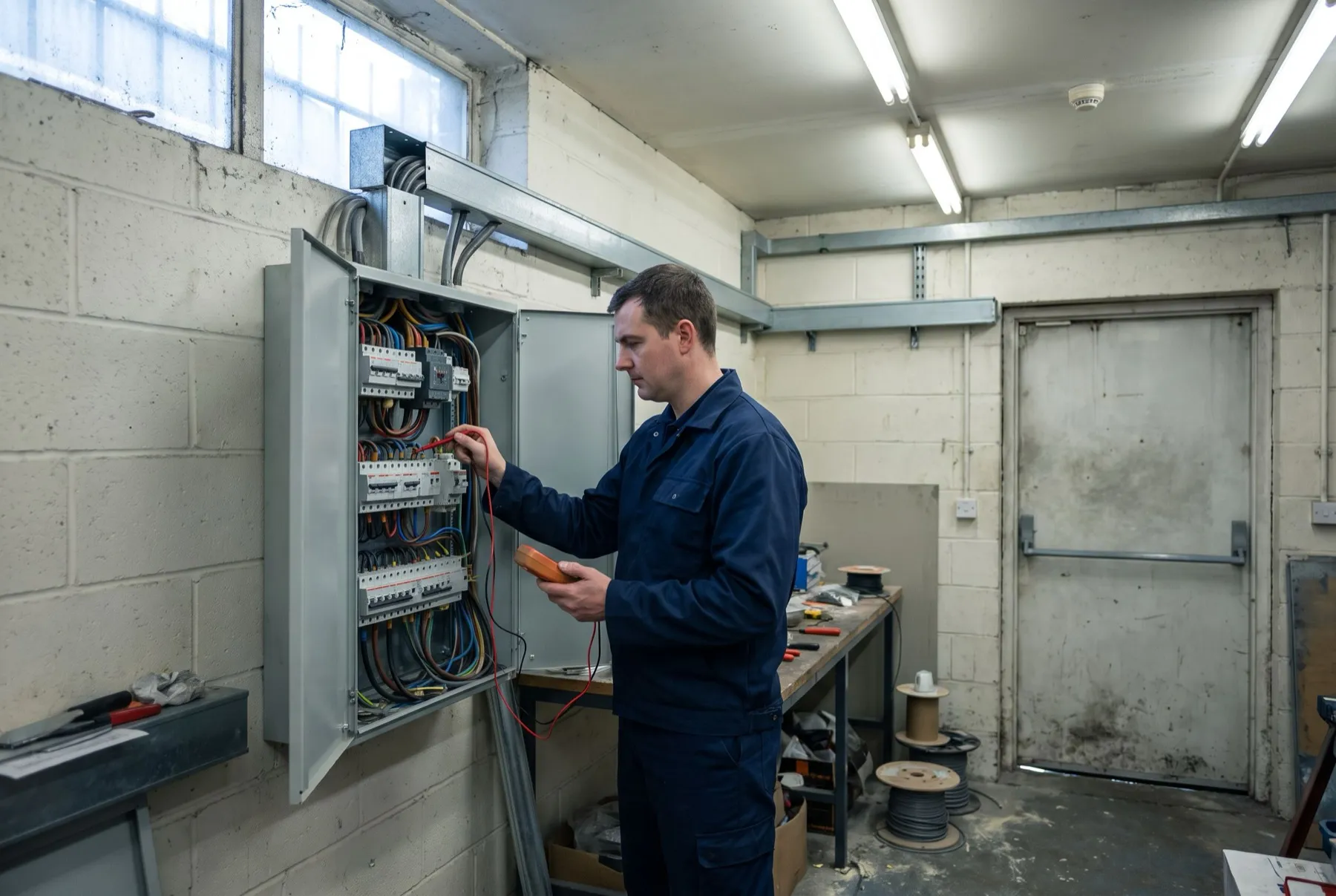
Load management is a controller that watches how much power your building is using and shares what’s left between the chargers. When the kettles and machines are on, the chargers slow down; when demand drops, they speed back up.
Northern Powergrid’s own guide recommends load sharing for sites with several chargers. On many workplace jobs it’s the difference between using the supply you have and paying for a bigger one.
Notify or apply first
Every charger has to be reported to Northern Powergrid. If the installation meets its notification criteria, the installer fits the charger and notifies within 28 days.
If it doesn’t, the installer has to apply before connecting. For multiple chargers, Northern Powergrid advises speaking to its team before applying, and its AutoDesign tool shows where the local network has capacity.
If you need a bigger supply
A supply upgrade means a quote and a connection date from Northern Powergrid, and the timescale depends on the work involved. Ask them for current timescales early, or ask us to raise it as part of the survey.
This is the part of a project you can’t speed up from your side. It’s also the main reason to start well before the grant deadline.
What does workplace EV charging cost?
There’s no single price, because two sites with the same number of chargers can need very different work. The chargers are only part of the bill.
We price each job after a survey or from photos, and the quote comes back fixed with the grant already taken off. These are the things that move the figure:
- Chargers and sockets. How many, 7kW or 22kW, and wall-mounted units or freestanding pedestals.
- Cable runs. The distance from your board to the parking bays, and how the cable gets there: on a wall, through a ceiling void or underground.
- Groundworks. Trenching across tarmac or block paving, ducting and making good afterwards.
- Your board and supply. A new sub-board, three-phase work, load management or an upgrade from Northern Powergrid.
- Back office and software. Access control, payment and reporting can carry an ongoing subscription per charger, so ask about running costs as well as the fitted price.
How much the grant takes off
The Workplace Charging Scheme pays up to 75% of the cost, capped at £500 per socket. These are the most it can pay at a few common sizes:
| Site | Sockets | Grant up to |
|---|---|---|
| One twin-socket charger | 2 | £1,000 |
| Two twin-socket chargers | 4 | £2,000 |
| Five twin-socket chargers | 10 | £5,000 |
The two caps work together. If a job comes in at less than £667 per socket including VAT, the 75% limit kicks in before the per-socket one.
The Workplace Charging Scheme and its deadline
The Workplace Charging Scheme is the government grant for chargers at businesses, charities and public sector sites. It pays up to 75% of the cost, capped at £500 per socket, for up to 40 sockets, so £20,000 at most.
The rate rose on 1 April 2026, so guides written before then quote a lower figure. The government has extended the scheme to 31 March 2027 and calls it a final year.
For eligibility in full, see our Workplace Charging Scheme guide. For the form itself, we’ve written up how to apply for a voucher, step by step.
Work backwards from the deadline
A voucher lasts 180 days from the day it’s issued, and the chargers have to be installed and claimed inside that window. If your site needs a Northern Powergrid upgrade, that stage has to fit in too.
So get the survey done first, find out whether the supply is enough, and only apply once a realistic install date is known. A voucher that runs out can’t be extended, only withdrawn and replaced.
State-funded schools apply under a separate version of the scheme, worth up to £2,000 per socket. Our school EV charging page covers how that works.
Is free charging at work a taxable benefit?
Usually not. Since 6 April 2018, electricity and charging facilities provided at or near the workplace have been exempt from Income Tax and National Insurance, as long as they’re available to your employees generally.
That’s HMRC’s position. It covers staff’s own cars as well as company vehicles.
Two limits to be aware of:
- The exemption doesn’t cover paying staff back for charging somewhere else, such as at home or on the public network.
- Company cars and vans are taxed under the car or van benefit, and charging them is treated as a connected cost under a separate exemption.
Tax depends on how your scheme is set up, so check your own situation with your accountant.
Rules and paperwork to check first
Before you commit, run through this list:
- An OZEV-authorised installer. Any qualified electrician can fit a charger, but only an authorised installer can claim the grant for you.
- Smart charger rules. The Electric Vehicles (Smart Charge Points) Regulations 2021 cover private chargers sold for workplace use in Great Britain. Rapid chargers and public chargers are exempt, as gov.uk explains.
- Chargers you’re required to fit. If building regulations (Part S in England) or a planning condition makes you install chargers, those chargers can’t be grant-funded.
- Your landlord. If you lease the site, you need their agreement, and the parking has to be clearly associated with your premises.
- Northern Powergrid. Notification or an application, as covered above.
- The subsidy limit. The grant counts towards the £315,000 minimal financial assistance limit over 3 financial years.
How a workplace installation runs with us
Every job follows the same three steps:
- Site survey. We check the incoming supply and boards, look at the parking, and talk through how many sockets you need now and later.
- Design and fixed quote. You get a written design and a fixed price, with the grant applied. You apply for the voucher with our quote, and we walk you through the form.
- Install, certify and hand over. We fit around your working hours, certify the work, notify Northern Powergrid and claim the grant.
We schedule the disruptive parts, like trenching, around your working hours. At handover we set up the access and payment option you’ve chosen and show your team how it works.
Workplace charging works best when it’s sized for the drivers you have, wired for the ones coming and planned around the supply. The grant helps, but only if the survey and the voucher fit inside 31 March 2027.
Our commercial EV charger installation page covers the kinds of sites we work on. Send us photos of your car park and fuse board through the quote form and you’ll get a fixed price with the grant already taken off.