
EV charging with no driveway: what each council in North Yorkshire and the North East allows
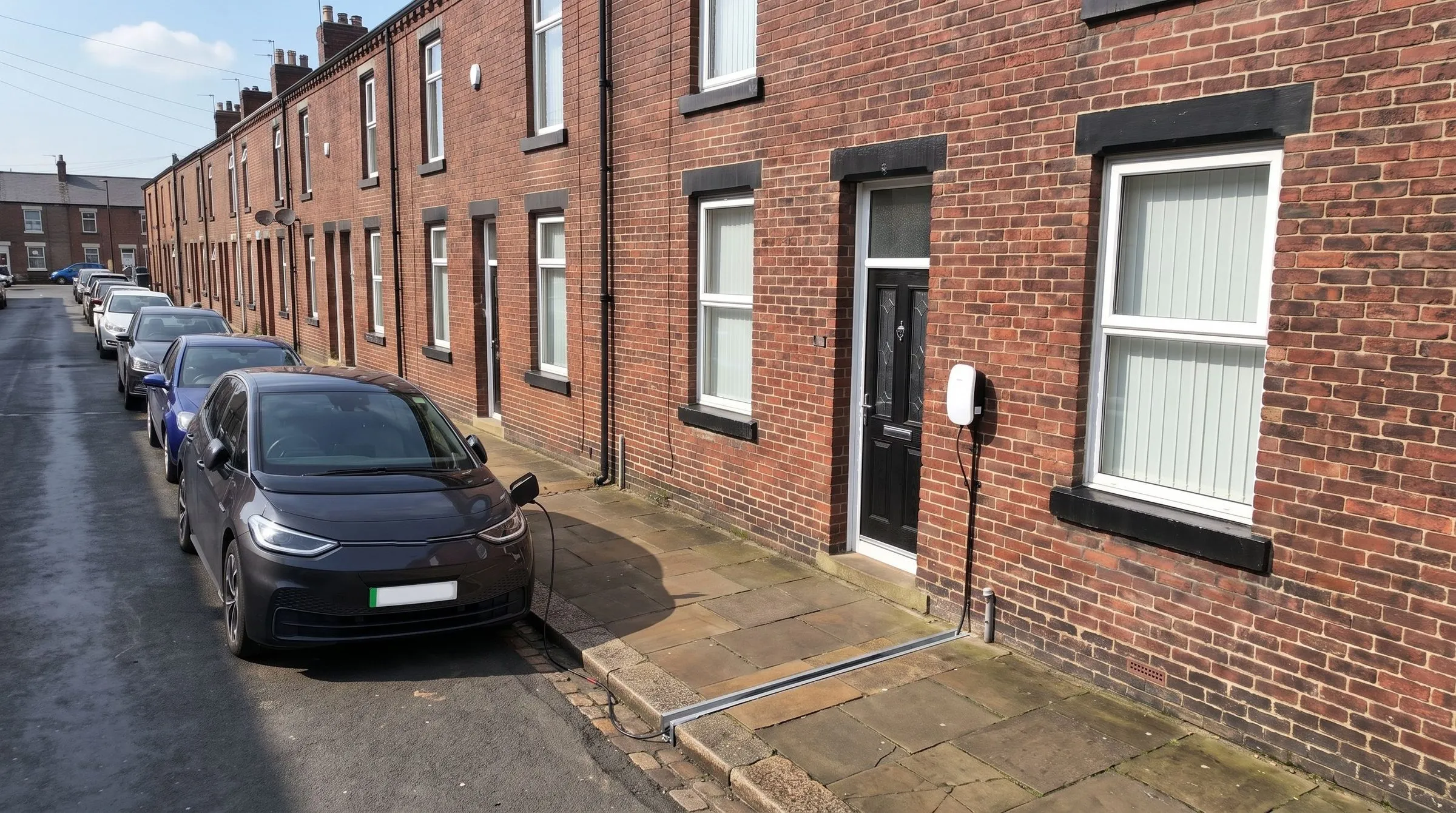
Whether you can charge an EV with no driveway comes down to one thing: what your council allows on the pavement outside your house.
Across North Yorkshire and the North East, that answer changes from one council to the next. We fit home chargers across this whole area, so on 7 October 2026 we checked every council’s own published position and set them out below, with a link to each source.
Can you charge an EV at home with no driveway?
Yes, but only where your council allows it. A loose cable across the pavement is a trip hazard councils won’t accept, so on-street households need a council-approved cross-pavement channel: a slim, flush tray in the footway that carries the cable from your house to the kerb.
Right now Sunderland is trialling channels and Durham and Newcastle have schemes in progress. Middlesbrough and Stockton haven’t published a clear policy, and York, Darlington, North Yorkshire and Redcar & Cleveland don’t allow them.
What each council allows
| Council | Covers | Position |
|---|---|---|
| Sunderland City Council | Sunderland | Trial runningThe council is trialling Kerbo Charge cross-pavement channels at a reduced cost to residents, with plans to make them available across the city. |
| Durham County Council | Durham, Chester-le-Street, Bishop Auckland, Spennymoor | Scheme in progressThe council offers cross-pavement charging for residents who park on the street, and asks you to contact its cross-pavement team first. |
| Newcastle City Council | Newcastle | Scheme in progressThe council is developing a cross-pavement pilot, backed by £1.2 million the North East Mayor secured from the Cross Pavement Charging Fund, and will take applications once it launches. |
| Middlesbrough Council | Middlesbrough | No published policyThe council hasn’t published a policy on cross-pavement charging, so we ask its highways team in writing before quoting a channel. |
| Stockton-on-Tees Borough Council | Stockton-on-Tees, Yarm, Ingleby Barwick, Thornaby, Billingham | No published policyThe council doesn’t allow cables across the pavement in residents’ parking zones. Elsewhere there’s no published policy, so we ask in writing before quoting. |
| City of York Council | York | Not allowedThe council doesn’t allow charging cables across the pavement, including gully channels, cable protectors and ramps. |
| North Yorkshire Council | Harrogate, Ripon, Northallerton, Thirsk, Knaresborough | Not allowedThe council doesn’t currently allow it. It is trialling cross-pavement solutions, but expressions of interest are closed and may reopen later. |
| Darlington Borough Council | Darlington | Not allowedThe council’s EV charging policy (February 2025) doesn’t allow cables to run across, through or over the highway from a home. |
| Redcar & Cleveland Borough Council | Redcar, Guisborough, Saltburn | Not allowedThe council advises against trailing cables across the pavement or road, even with a protective cover, and points residents to public chargers. |
Some of these need more than a one-line summary.
Sunderland: a trial you can ask about now
Sunderland City Council is trialling Kerbo Charge cross-pavement channels. It started in August 2025 with 20 channels at a substantially reduced cost to residents, and says it will then work to make them available across the city.
If you live in Sunderland and park outside your house, email the council’s EV team at evcharging@sunderland.gov.uk first. We fit the home charger the channel connects to: see EV charger installation in Sunderland.
Durham and Newcastle: schemes on the way
Durham County Council’s electric vehicles page says cross-pavement charging lets residents charge at home while parked on the street. It asks you to contact its cross-pavement team at EVCrossPavementSolutions@durham.gov.uk to find out more.
Newcastle City Council is developing a cross-pavement pilot and says it will accept applications from residents once it launches.
That pilot is backed by £1.2 million the North East Mayor, Kim McGuinness, secured from the Cross Pavement Charging Fund to help more than 1,000 households.
Middlesbrough and Stockton: ask before you buy
Middlesbrough Council hasn’t published a policy on cross-pavement charging that we could find. Its vehicle crossing licence covers dropped kerbs for driveways, not charging cables, so don’t treat it as permission.
Stockton-on-Tees Borough Council’s residents’ parking zone policy is explicit: ‘It is not permitted to run cables from an EV charge point across the pavement to a vehicle parked within an RPZ.’ Outside those zones it hasn’t published a position.
In both towns we ask the highways team in writing before we quote for a channel.
York, Darlington, North Yorkshire and Redcar & Cleveland: not allowed
City of York Council is the clearest of all. Charging on the street ‘by trailing a cable across the pavement, including the use of gully products, a cable protector or cable ramp is not-permitted.’
Darlington Borough Council’s EV charging policy, published in February 2025, says the same in its own words: ‘We do not permit charging from properties that requires cables to run across, through or over the highway.’
North Yorkshire Council, which covers Harrogate, Ripon, Northallerton and Thirsk, ran expressions of interest for a cross-pavement trial. They’re closed for now, though the council says they may reopen.
Redcar & Cleveland Borough Council advises against trailing cables across the pavement or road, ‘even where some kind of protective cover is used’.
Why you can’t just run a cable across the pavement
The pavement is public highway, and councils have a duty to keep it safe to walk along. North Yorkshire Council says trailing a cable across it ‘is not allowed under the Highways Act 1980, as it creates a trip hazard’.
There’s a personal risk too. Darlington’s policy warns that cables across the highway could ‘lead to claims against the Council and householders’ from people injured in slips, trips and falls.
Cable covers and ramps don’t get round it. York bans them by name, and the on-street route of the EV chargepoint grant is for a permanent cross-pavement solution your council has approved.
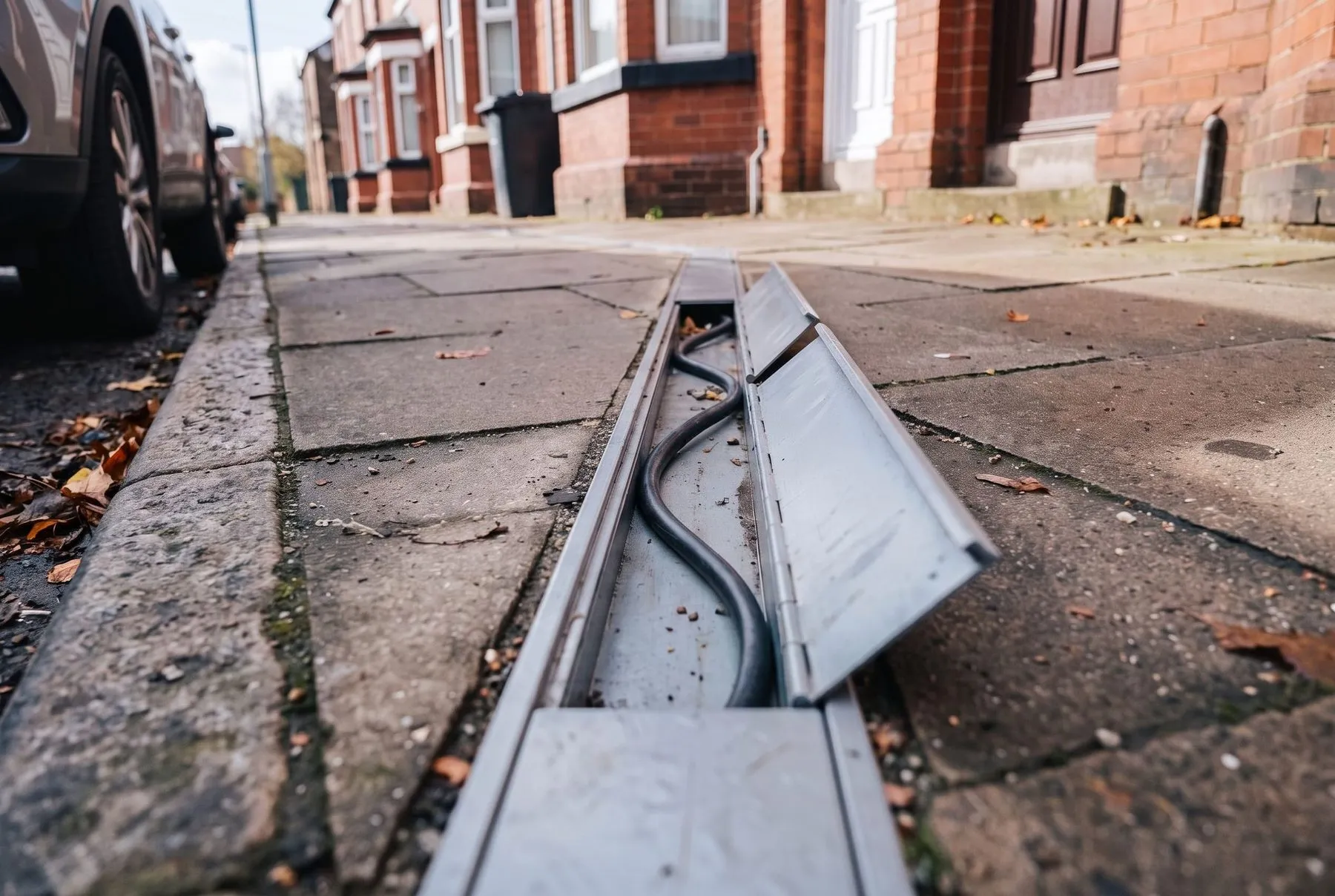
If your council allows it: how a cross-pavement channel works
A cross-pavement channel is a narrow tray cut into the footway and finished level with the surface. Your charging cable lies inside it under a cover, so the pavement stays clear whether you’re charging or not.
The order of the steps matters:
- Council permission first. The highways team has to approve a channel for your stretch of pavement before anything else happens.
- Then the grant. With permission in place, on-street households can apply for the EV chargepoint grant: 75% of the charger and installation, up to £500.
- Then the install. The charger goes on your front wall, the channel goes in, and the electrical work is certified and notified to Northern Powergrid.
Two things to know before you commit. The grant covers the chargepoint, not the channel, so the channel and any council fee are paid for separately.
And a channel doesn’t reserve the space outside your house. Think about how often your street fills up in the evening.
Our cross-pavement charging page has the full process and what each part costs.
If your council says no: your options
Park on your own land
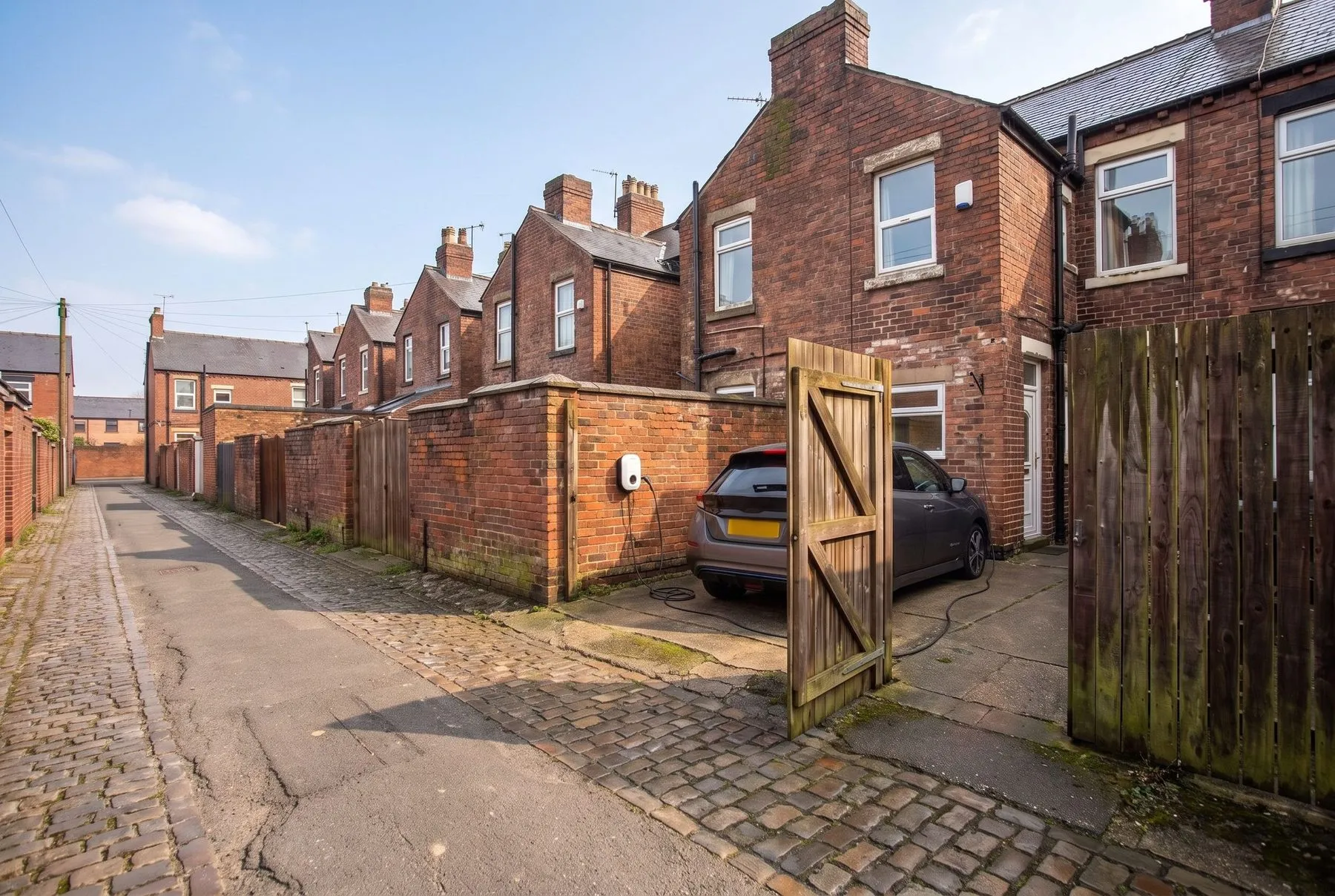
Lots of terraced houses have a rear yard, a garage or parking off a back lane. If your car can sit inside your own boundary, a charger on the back wall needs no pavement at all.
That’s a standard home installation, from £916 fully fitted. Just make sure the car is on your land when it charges, so the cable never crosses a public footway or lane.
Renters and flat owners with their own space
If you rent, or own a flat, and have a parking space you can use, you can still claim the EV chargepoint grant of up to £500. We check you qualify and take it off your quote.
Charge at work
If your employer has staff parking, the Workplace Charging Scheme pays £500 per socket towards chargers there.
It’s worth raising with them. A charger at work covers most commuting without touching the pavement at home.
Public charging
On-street and rapid public chargers fill the gap, but you’ll pay more than charging at home.
For context, the standard price-capped electricity rate is 26.32p per kWh (Ofgem’s average for October to December 2026), and overnight EV tariffs come in well under that. Home charging is usually the cheapest way to run an EV where you can get it.
What it means where you live
- York: no channels. If you have a rear yard or garage, see EV charger installation in York.
- Harrogate and Ripon: North Yorkshire’s trial is closed for now, so off-street parking is the route. See Harrogate and Ripon.
- Darlington: not allowed under the council’s 2025 policy. Off-street installs are covered on our Darlington page.
- Durham: contact the council’s cross-pavement team first. See EV charger installation in Durham.
- Newcastle: watch for the council’s pilot opening to applications. See EV charger installation in Newcastle.
- Sunderland: ask the council about the Kerbo Charge trial. See EV charger installation in Sunderland.
- Middlesbrough and Stockton: no clear policy, so get the council’s answer in writing first. See Middlesbrough and Stockton-on-Tees.
Check your street before you buy an EV
- Find your council in the table above and read its source page.
- If you’re in Stockton, check whether your street is in a residents’ parking zone.
- Look for an off-street option: a rear yard, a garage, or a back lane space on your own land.
- Send us photos of your parking through the quote form, and we’ll tell you what can go where before you spend anything.
Councils are changing these rules, especially in the North East, where new funding is arriving. We’ll update this guide when they do, and the table shows when we last checked.