
Tethered or untethered EV charger: which should you choose?
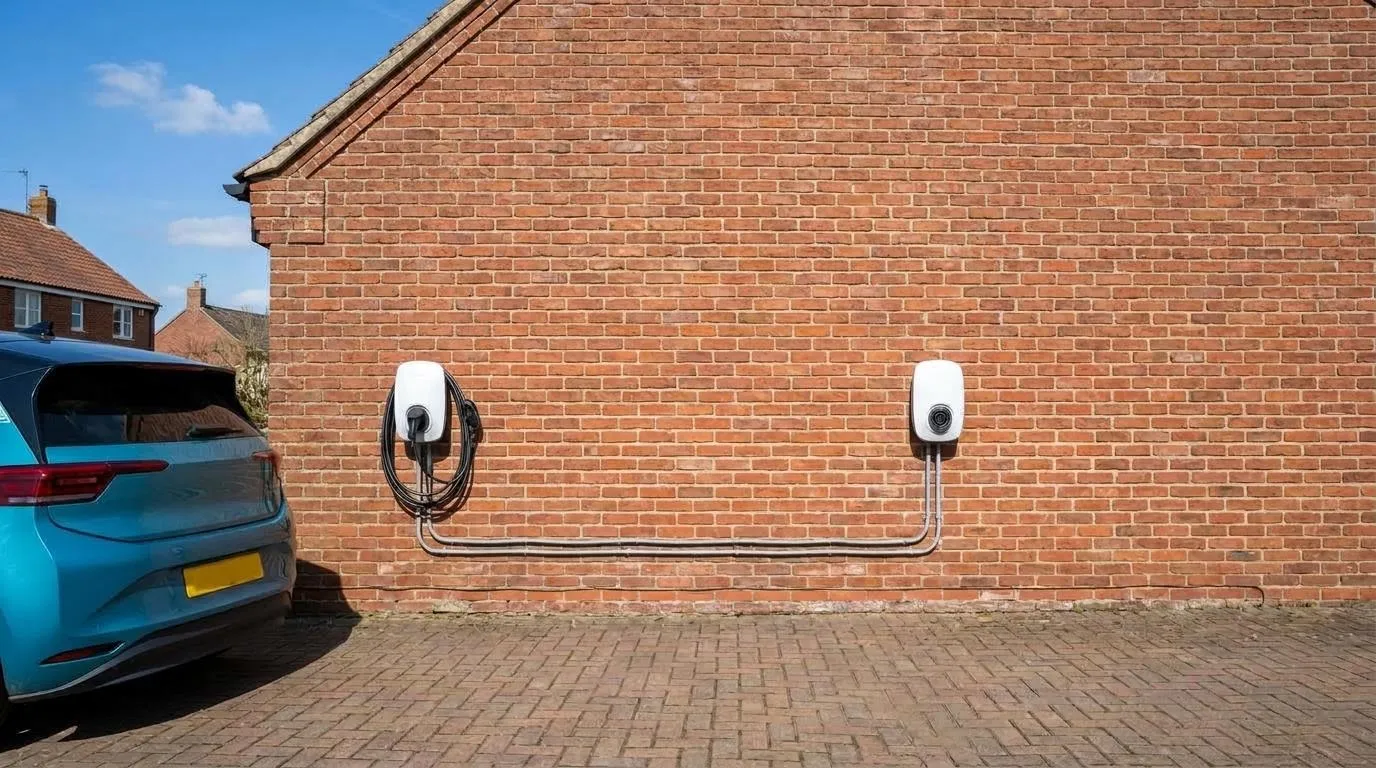
A tethered EV charger has its own cable fixed to the unit, so you take it off the holster and plug into the car. An untethered charger has a Type 2 socket instead, and you plug in your own cable each time.
Both charge at the same speed. The right choice depends on where you park, how far the cable has to reach and how much you mind a lead hanging on the wall.
We fit both types across North Yorkshire and the North East, and our quote form asks this exact question. Below is how we help customers decide, with the fixed fitted prices for every charger we offer for home EV charger installation.
The difference in one table
Tethered and untethered chargers do the same job. The differences are all about the cable.
| Tethered | Untethered | |
|---|---|---|
| Cable | Fixed to the charger | Your own Type 2 cable, plugged in each time |
| Charging speed at home | Up to 7kW | Up to 7kW, with a 32A cable |
| Plugging in | Unhook the lead, plug into the car | Get the cable out, plug in at both ends |
| Cable length | Set when it’s fitted (5m on the ones we fit) | Whatever cable you buy |
| Works with older Type 1 cars | Only if the lead is Type 1 | Yes, with a Type 2 to Type 1 cable |
| On the wall between charges | Charger plus coiled lead | Just the charger |
| Cable theft | Can’t be taken without tools | A cable left in the socket can be unplugged when it isn’t charging |
Do untethered chargers charge slower?
No. On a normal single-phase home supply, both types charge at up to 7kW, which the Energy Saving Trust puts at roughly 7 miles of range for every 20 minutes plugged in.
The car’s onboard charger sets the real limit, not whether the cable is fixed. That’s true whichever type you choose.
There’s one catch with untethered chargers. Type 2 cables come rated at 16A or 32A, and a 16A cable caps charging at around 3.6kW on a home supply.
If the cable that came with your car is 16A, it will work, just at half the speed. Buy a 32A cable if you want the full 7kW.
Why people choose a tethered charger
Convenience is the reason most people give. The lead is always there, so plugging in takes a few seconds and there’s nothing to fetch from the boot on a wet evening.
On our Ohme Home Pro install in Northallerton, the charger is in the garage beside the car. The tethered lead sits on its own holster on the blockwork, so it’s off the floor and ready the next time the car comes in.
The other advantages are practical:
- Nothing to steal. The lead is fixed into the unit, so it can’t be unplugged and walked off with.
- Your car’s cable stays in the boot. Keep it for public chargers and it never gets worn out on the driveway.
- Nothing to forget. You can’t leave the house without the cable, because it never leaves the wall.
The downsides are the lead itself. It’s on show all the time, the length is fixed when we fit it, and a thick cable is stiffer to coil on a frosty morning.
Why people choose an untethered charger
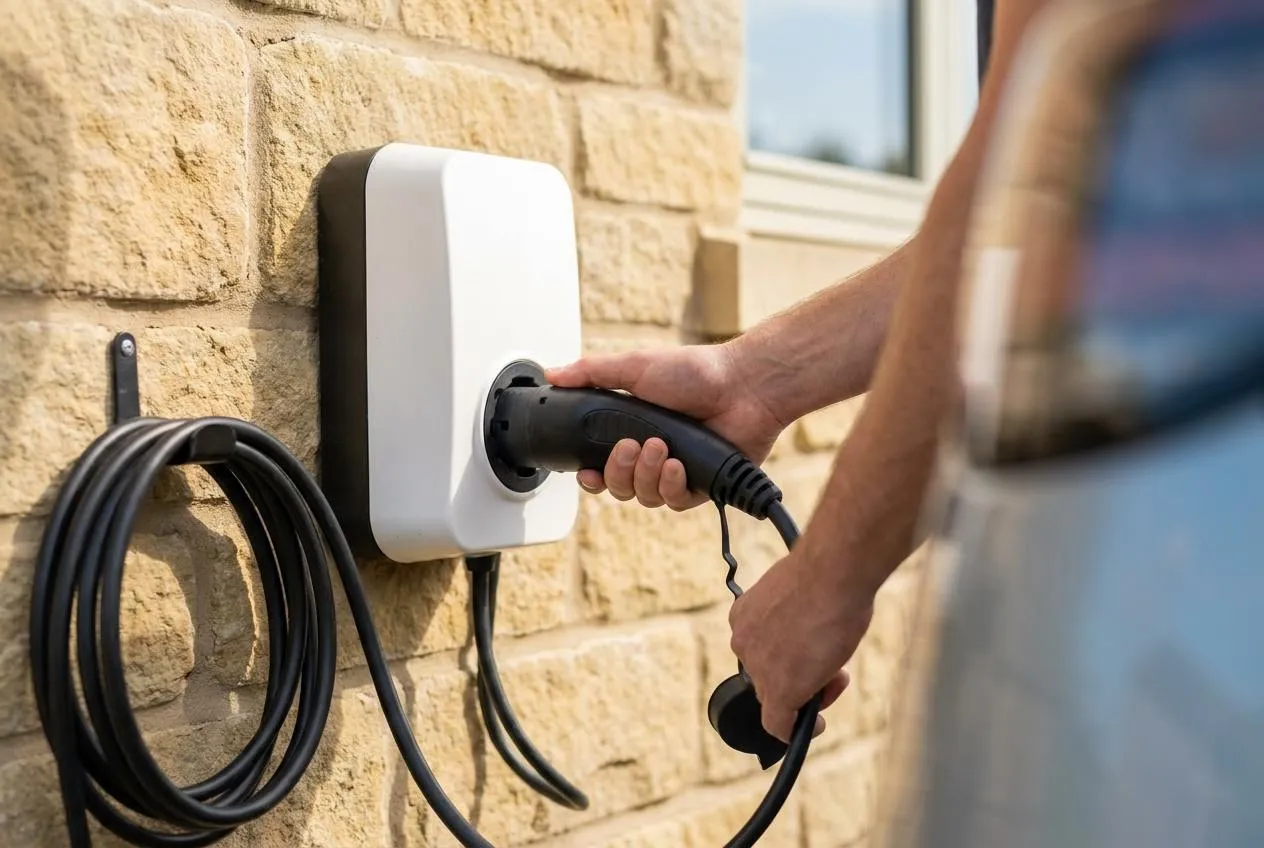
An untethered charger is just the unit and a socket. That’s the main reason people choose one: on a front wall facing the street, it looks tidier.
On our Project EV Apex 7S install in Yarm, the charger went on the side wall right beside the driveway. The homeowner chose untethered so there’s nothing hanging on the wall between charges.
It also gives you more choice:
- Any cable length. If your car’s charging port is a long way from the wall, buy a longer cable instead of moving the charger.
- Older cars. Some earlier EVs and plug-in hybrids use a Type 1 inlet. A Type 2 to Type 1 cable lets them use the same charger.
- More than one car. Visitors and second cars can plug in with their own cable.
The trade-off is handling a cable every time. It goes back in the boot wet and muddy after a winter night, or it stays plugged into the socket, where most chargers only lock it in while a charge is running.
Some untethered chargers let you lock the cable in permanently from the app. That turns them into a tethered charger in all but name, and we’ll tell you which models can when we quote.
What each type costs fitted
These are our fixed fitted prices, including the charger, up to 5 metres of cabling, a dedicated circuit, certification and Northern Powergrid notification.
| Charger | Type | Fitted price |
|---|---|---|
| Project EV Apex 7S | 7kW, untethered | £800 |
| Easee One | 7kW, untethered as standard | £916 |
| Ohme ePod | 7kW, untethered | £930 |
| Ohme Home Pro | 7kW, 5m tethered cable | £968 |
| Hypervolt Home 3 Pro | 7kW, 5m tethered cable | £1,060 |
| myenergi Zappi | 7kW, tethered, solar-compatible | £1,142 |
Our three untethered chargers are also our cheapest, starting at £800 for the Project EV Apex 7S. Our tethered chargers start at £968 for the Ohme Home Pro, £168 more.
That gap isn’t only the cable. The chargers differ in features too, so compare the whole unit, not just the lead.
If you choose untethered and don’t already have a suitable cable, we can add one as an option on your quote. The installation cost page lists every extra and what changes the price.
How far the cable has to reach
This is the question that settles it for a lot of people. A tethered lead has to reach your car’s charging port with some slack, along the route it will actually take.
The tethered chargers we fit come with a 5 metre lead. That covers most driveways when the charger sits beside the parking space, and we can fit a longer lead if you need one.
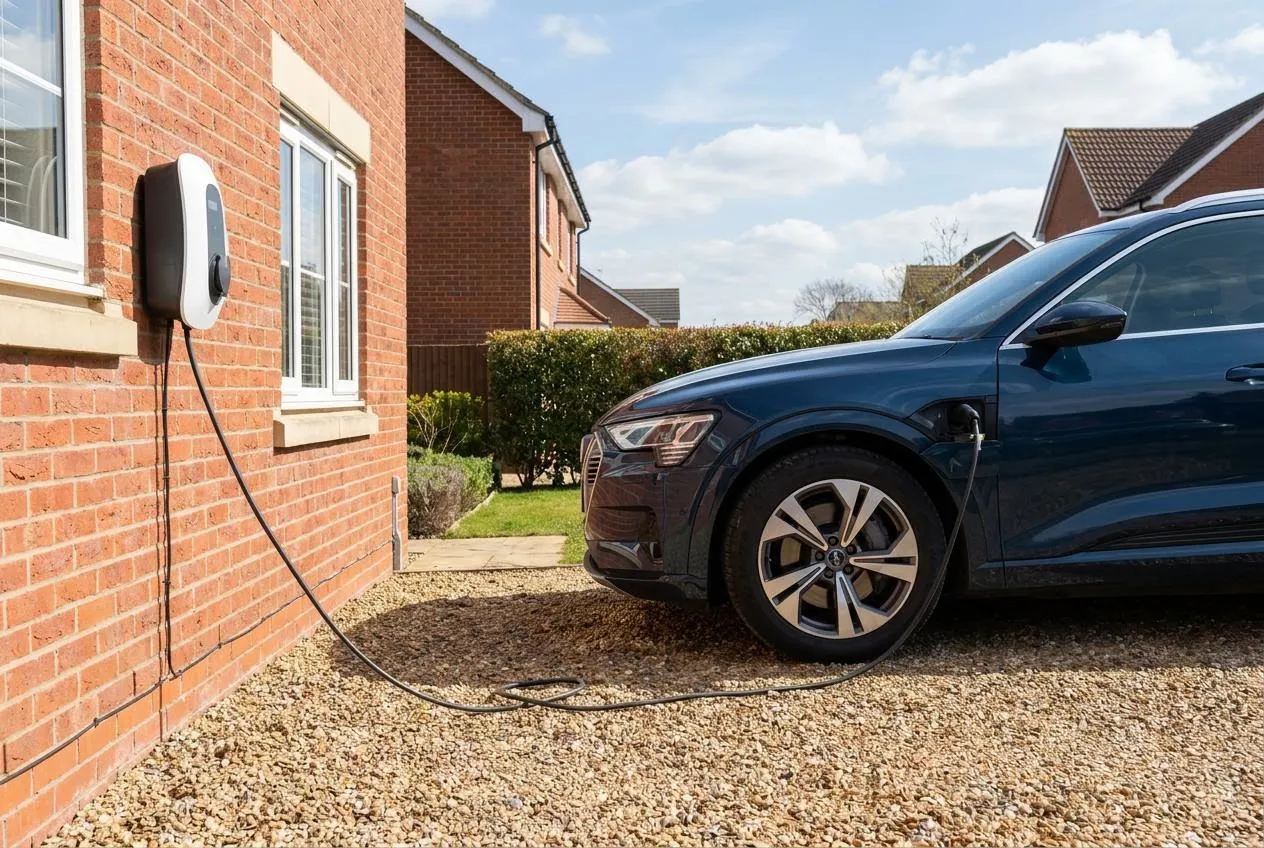
Before you decide, check where the charging port is on your car. Some cars have it on the front wing, some at the back and some in the nose. Reversing in instead of driving in can change the distance by a few metres.
The photos you send with the quote form show us where the car parks. We’ll place the charger so the lead reaches, or tell you if an untethered charger and a longer cable would work better.
Which should you choose?
Our advice, based on how people actually park and plug in:
- Choose tethered if you have one car, park in the same spot most nights and want the quickest plug-in. It also suits a garage or a side wall out of view.
- Choose untethered if the charger will be on a front wall, the car doesn’t always park in the same place, you have more than one EV, or your car uses a Type 1 inlet. It’s also the lower fitted price in our line-up.
Charger features can decide it as well. Our two solar-compatible chargers, the Hypervolt Home 3 Pro and the myenergi Zappi, are both tethered.
If you want Ohme’s smart-tariff scheduling, you get a choice: the Ohme Home Pro is tethered and the Ohme ePod is untethered. Our home installation page matches chargers to solar panels, smart tariffs, two-car homes and tight budgets.
Still not sure? Pick ‘Not sure, advise me’ in the quote form. Send a photo of where you park and one of your fuse board, and we’ll recommend a charger and send back a fixed price.